Water helpers
The helpers in the BrewForge water dialog: blend ratio from volumes or conductivity, metabisulfite in ppm, mash/sparge salt split, calcium chloride form, acid stage, acid suggestion and acidulated malt, with formulas and worked examples.
The water dialog (Water → Adjust on the Recipe tab) has a few small calculators for the steps that are easy to get wrong: how much of a second water you use, how many grams of metabisulfite give a certain ppm, how salts split between mash and sparge, and how much acid or acidulated malt brings the mash pH down. This page explains each one. Nothing a helper does is saved until you click Save water.
Blend ratio from volumes
With a second water (Dilute with second water), the share of the first water is a percentage next to the blend line (Share of Distilled/RO Water). Instead of working it out yourself, click from volumes (L) and enter how many litres of the second water you use.
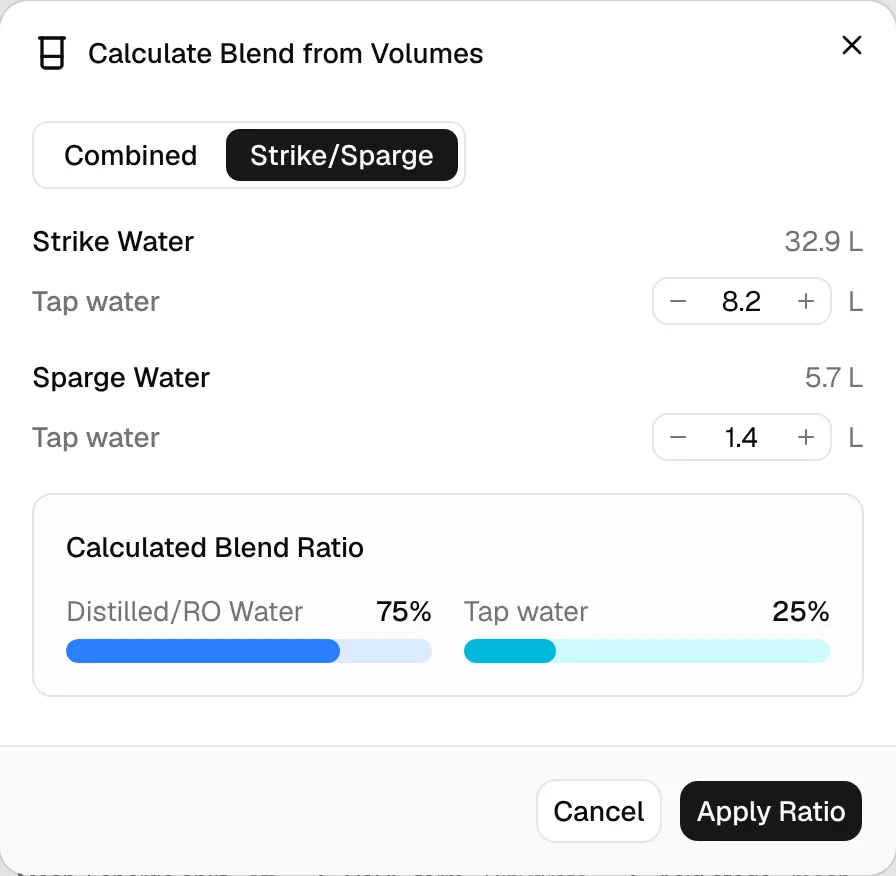
- Combined: the dialog shows the recipe's Total Water. Enter the litres of the second water; the litres of the first water follow.
- Strike/Sparge: enter the second water per stage, next to the recipe's Strike Water and Sparge Water.
The dialog opens with the litres that match the current share, spread over strike and sparge in proportion to their volumes. Calculated Blend Ratio shows both shares as bars; Apply Ratio sets the share in the water dialog (clamped to 0–100 %).
share of first water = (total water − second water) / total water × 100, rounded to whole percent
In Strike/Sparge mode, second water = second water in strike + second water in sparge. From calculateBlendRatioFromVolumes and getVolumeBlendSource2Liters in lib/brewing/water-blend.ts.
Example: 32.9 L strike and 5.7 L sparge = 38.6 L total. 8.2 L + 1.4 L tap water = 9.6 L → (38.6 − 9.6) / 38.6 = 75 % distilled water, 25 % tap water.
Blend ratio from conductivity
If you blend by measuring instead of by volume, click conductivity. Enter the conductivity in µS/cm of both waters and of your mix (Measured Blend). A value saved in the water profile shows as the grey placeholder and is used unless you type another one.
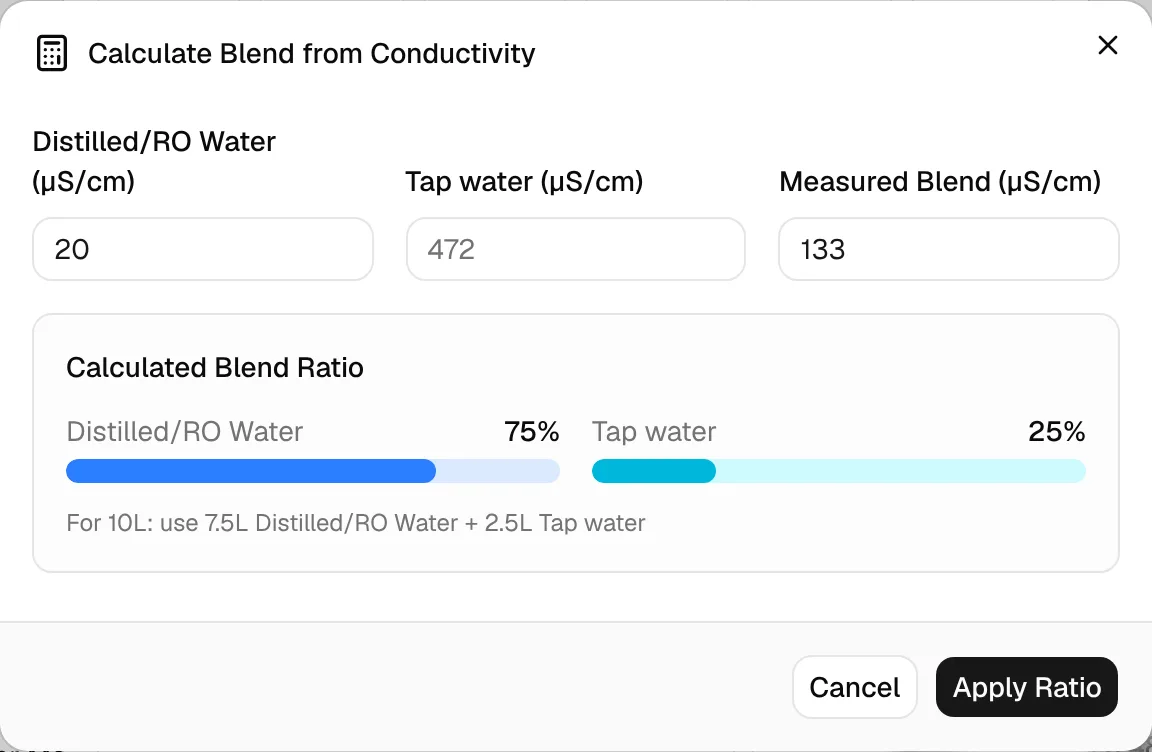
Calculated Blend Ratio shows the shares and how much of each to use for 10 L ("For 10L: use 7.5L Distilled/RO Water + 2.5L Tap water"). Apply Ratio takes over the share.
The dialog warns when a conductivity is missing, and when the measured value isn't between the two waters (Measured must be between 20.0 and 472.0 µS/cm): a blend can't conduct more or less than both of its parts. With two equal conductivities there is nothing to calculate.
measured = first × share + second × (1 − share), so share = (measured − second) / (first − second)
Conductivity is treated as mixing linearly, which holds well for the dilute water brewers use. From calculateBlendRatioFromConductivity in lib/brewing/water-blend.ts.
Example: distilled water 20 µS/cm, tap water 472 µS/cm, mix measured at 133 µS/cm: (133 − 472) / (20 − 472) = 0.75 → 75 % distilled, 25 % tap water.
Metabisulfite from ppm
Potassium and sodium metabisulfite (campden) bind dissolved oxygen in low-oxygen (LODO) brewing and remove chloramine from tap water. They are dosed in ppm rather than grams. After you add one with Add salt, its row has a ppm button that opens Metabisulfite (ppm).
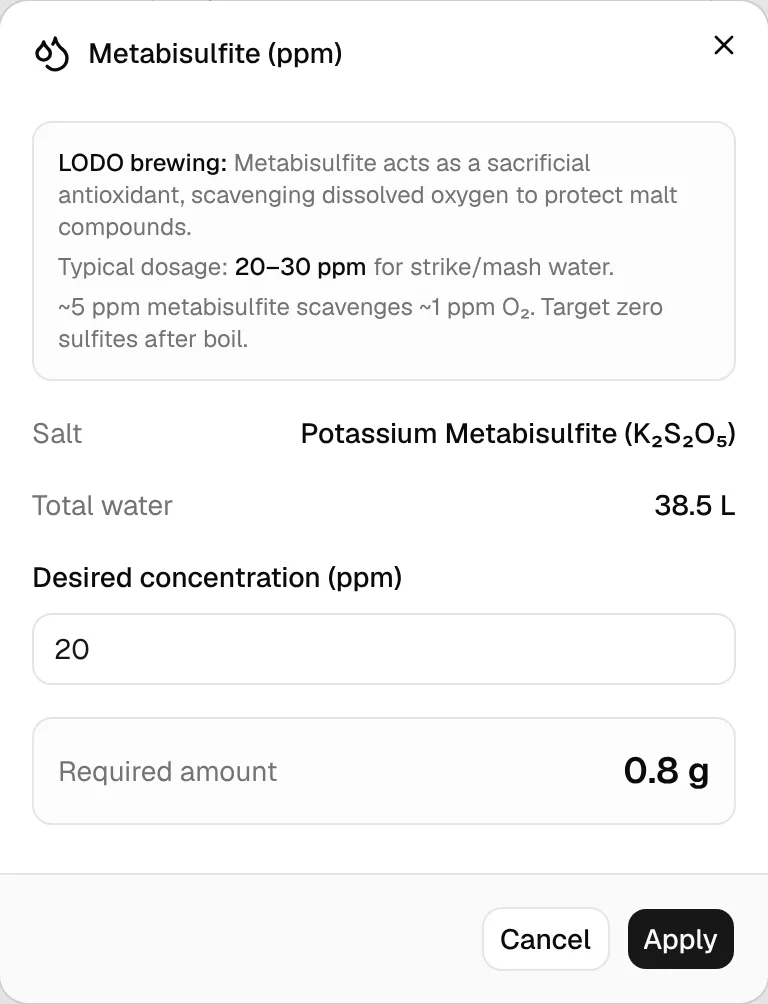
The dialog shows the salt, the recipe's Total water and, if the row already has grams, the Current dosage in ppm. Enter the Desired concentration (ppm) (20 when nothing is set yet); Required amount shows the grams and Apply writes them into the salt row. The box at the top gives the usual guidance: 20–30 ppm for strike and mash water, about 5 ppm metabisulfite per 1 ppm of oxygen. Above 100 ppm the dialog warns that the dose can lower the mash pH and affect the flavor. Without a water volume it can't calculate grams.
grams = ppm × total water L / 1000, rounded to 0.01 g
ppm = grams × 1000 / total water L, rounded to 0.1 ppm
ppm is mg per litre over all the water of the recipe (strike plus sparge). From metabisulfitePpmToGrams and metabisulfiteGramsToPpm in lib/brewing/salts.ts.
Example: 20 ppm in 38.5 L → 20 × 38.5 / 1000 = 0.77 g (shown as 0.8 g).
Like any salt, metabisulfite adds ions to the water: potassium metabisulfite adds sulfate, the sodium version sodium and sulfate. They show in the Result.
Salt and acid options
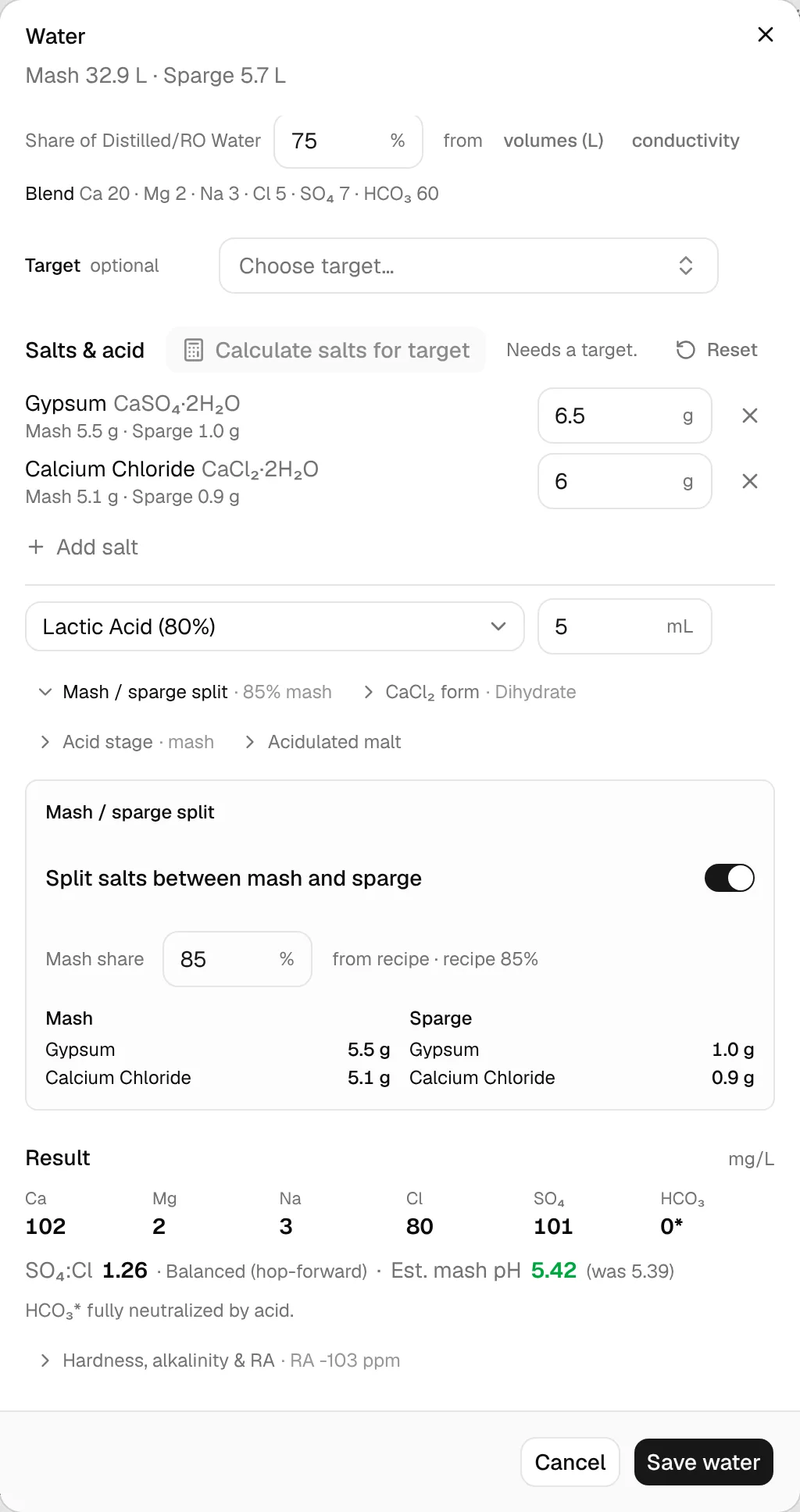
Below the acid row are four folds. Each shows its current setting in grey ("Mash / sparge split · 85% mash").
Mash / sparge split
Off, every salt goes into the mash water. Turn on Split salts between mash and sparge to add part of each salt to the sparge water, for example to keep the calcium in the sparge up. Mash share comes from the recipe's water volumes (from recipe · recipe 85%); type another value to override it. The fold lists how many grams of each salt go to Mash and Sparge, and every salt row shows "Mash 5.5 g · Sparge 1.0 g". Only the mash share of the salts changes the estimated mash pH. Without sparge water (BIAB) everything stays in the mash.
mash share = strike water / (strike water + sparge water)
mash grams = grams × mash share, sparge grams = grams × (1 − mash share), each rounded to 0.1 g. If the sparge part rounds to less than 0.2 g, all of the salt goes into the mash. From calculateMashWaterShare in lib/brewing/water-blend.ts and splitAdditions in lib/brewing/salts.ts.
Example: 32.9 L strike, 5.7 L sparge → 85 % mash. 6.5 g gypsum → 5.5 g mash, 1.0 g sparge. 0.2 g calcium chloride would give 0.1 g sparge, so all 0.2 g go to the mash.
CaCl₂ form
Calcium chloride is sold as Dihydrate (flakes), Anhydrous or as a Liquid solution; enter the Concentration for a liquid. The form changes how much calcium and chloride a gram (or millilitre) adds. A choice here applies Only for this recipe; Use global goes back to your setting under Settings → General → Calculations.
Acid stage
Where the selected acid goes: Mash, Sparge or Both. Only acid in the mash changes the mash pH (Sparge acid does not change mash pH). Each acid keeps its own stage, so you can use lactic acid in the mash and phosphoric acid in the sparge; the acid row then lists the others under Also in use.
Acidulated malt
If your grist contains acidulated malt, the fold shows how much and its estimated effect ("In recipe: 150 g (3% grist, -0.12 pH est.)"). If the estimated mash pH is above the target and you would rather use acidulated malt than liquid acid, it suggests an amount: "Instead of acid, add 110 g acidulated malt (2.2% of grist) to reach pH ~5.4". When the pH is already at or below the target it says so.
BrewForge adds acidulated malt to the grist in its mash pH model (3 % lactic acid, plus the malt itself) and searches for the amount that gives 5.4, to 0.5 g. The percent is of your current grist, rounded to 0.1 %. Suggestions stop at 10 % of the grist.
This is the same model that estimates the effect of acidulated malt already in the recipe (getRecipeAcidulatedMaltContribution in lib/brewing/ph.ts), so the suggestion and the recipe agree. The common rule of thumb, 0.1 pH per 1 % of grist, ignores the buffering of grain and water and suggests 10–25 % too little.
Example: 5 kg pale malt (6 EBC), 15 L mash water with 200 ppm bicarbonate → estimated pH 5.87 → 269 g acidulated malt (5.4 % of the grist). The rule of thumb would say 4.7 %.
Acid suggestion
When the estimated mash pH is above 5.4, the line under the acid row says how much more of the selected acid gets you there: "pH 5.62 is high · ~2.4 mL more reaches 5.4". It takes the acid's strength and the stage into account. For the dilute 10 % hydrochloric and sulfuric acid, a note reminds you that the calculation assumes a 10 % w/w solution and to check your product.
BrewForge searches for the millilitres at which the mash pH estimate reaches 5.4 (within 0.01, at most 200 mL), with each acid's strength in mEq per mL (lactic 88 % 11.5, lactic 80 % 10.3, phosphoric 10 % 1.07, phosphoric 85 % 14.6, citric 50 % 6.1, …). From calculateAcidAddition in lib/brewing/salts.ts.
For acid added to mash and sparge, only the mash part counts: amount at the stage = mash amount / (strike water / total water) (getAcidStageAmountForMashEffect). Example: 2.0 mL needed in the mash, 18 L strike of 30 L total → 2.0 / 0.6 = 3.3 mL.
Hardness, alkalinity & RA
The fold under the Result shows the mash water's Hardness, Alkalinity and residual alkalinity (RA) as ppm CaCO₃. A negative RA means the calcium and magnesium (and acid) outweigh the alkalinity. Formulas: Brew calculations → Water.
Related
- Water: the water dialog step by step.
- Water profiles: store conductivity and ions of your waters.
- Mash steps: the mash step dialog.