ABV Calculator
Calculate alcohol by volume (ABV) from original and final gravity in SG or °Plato, plus ABW, apparent and real attenuation, calories and carbs per serving.
The ABV and nutrition calculator turns your two gravity readings, before and after fermentation, into the alcohol content of your beer. It also shows how far the yeast fermented (attenuation) and estimates calories and carbohydrates per glass.
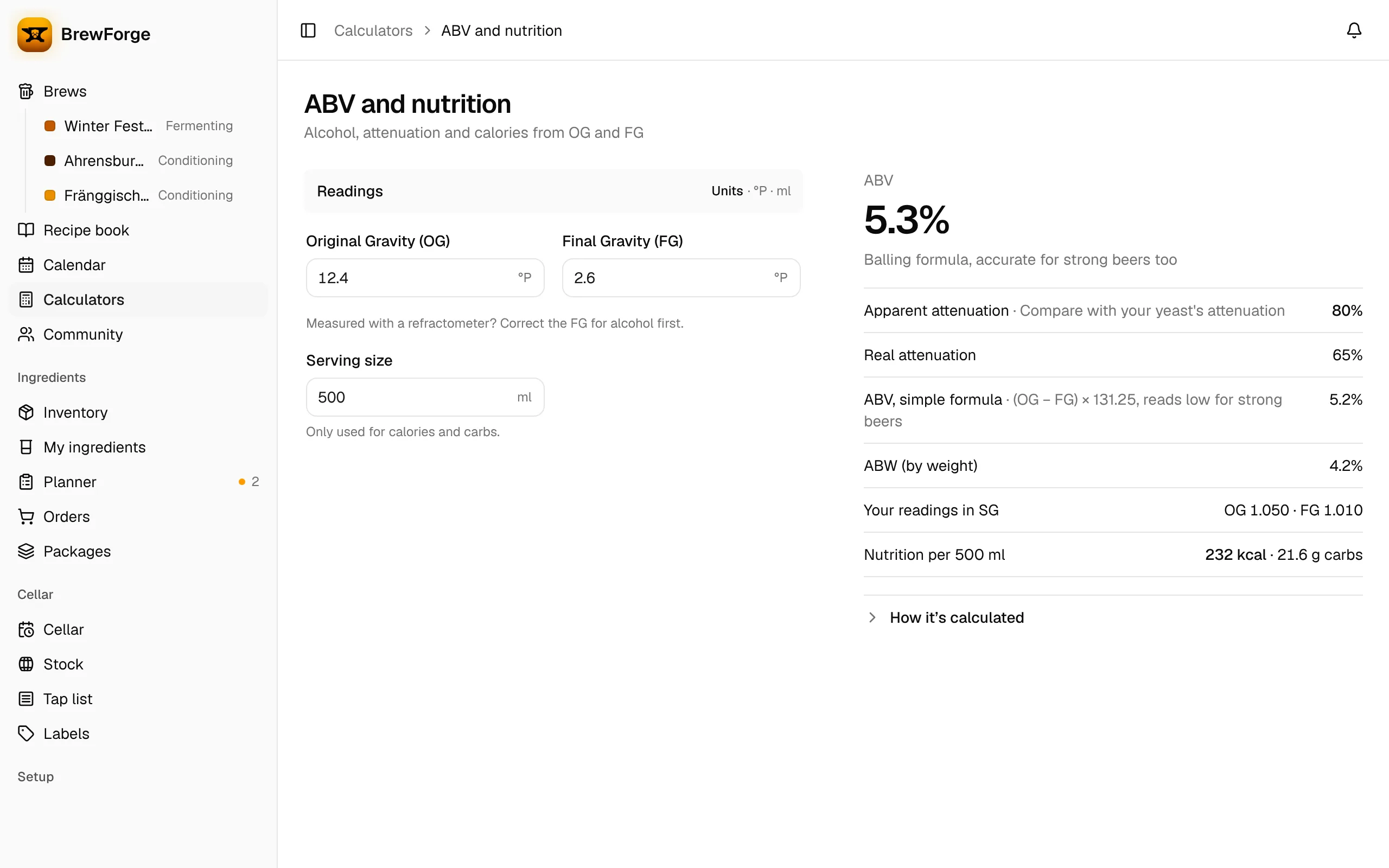
Open it under Calculators in the sidebar → ABV and nutrition. Enter your readings on the left; the answer on the right updates as you type (on a phone it stays pinned at the bottom of the screen).
Readings
| Field | What to enter |
|---|---|
| Original Gravity (OG) | The wort reading on brew day, before pitching the yeast. |
| Final Gravity (FG) | The reading after fermentation has finished. |
| Serving size | Only used for calories and carbs. Default 500 ml (12 fl oz with US units). |
Units in the Readings bar switches the Gravity between SG and °P and the Serving size unit between ml and fl oz. They start in your units from Settings; switching converts the values you entered. The defaults are a typical 5% ale: 1.050 and 1.010 SG, or 12.4 and 2.6 °P.
Measured with a refractometer? Alcohol distorts a refractometer reading of beer. Correct it first with the refractometer calculator and enter the corrected FG here.
The calculator catches common mistakes instead of showing a nonsense result:
- An OG of 12.4 with the unit set to SG looks like °Plato (and 1.050 with °P looks like SG). The hint has a link, Switch to °P or Switch to SG, that relabels the readings without converting them.
- An FG must be lower than the OG ("Did you swap them?").
- Readings outside realistic ranges (OG above 1.000 and up to 1.200, FG from 0.980) ask you to check the value.
Answer
The big number is the ABV from the standard formula, the one most recipes and labels use. Below it:
- Apparent attenuation: how much of the gravity the yeast removed. Compare it with the attenuation your yeast's manufacturer quotes.
- Real attenuation: corrected for alcohol, which is lighter than water and makes the hydrometer read low.
- ABV, alternate formula: more accurate above about 8%.
- ABW (by weight): alcohol by weight.
- Your readings in SG (or in °P): both readings in the other gravity unit.
- Nutrition per serving: calories and grams of carbs. Without a serving size you see a note to enter one.
How it's calculated below the answer opens the two ABV formulas.
Readings in °Plato are converted first: SG = 260.4 / (260.4 − °P).
ABV = 76.08 × (OG − FG) / (1.775 − OG) × FG / 0.794 (alternate formula, accurate for strong beers too)
ABV (simple formula) = (OG − FG) × 131.25, shown for comparison
ABW = 0.79336 × ABV / FG
Apparent attenuation = (OG − FG) / (OG − 1) × 100
Real attenuation works in °Plato: original extract OE = 260.4 − 260.4 / OG, apparent extract AE the same for FG, real extract RE = 0.1808 × OE + 0.8192 × AE, and real attenuation = (OE − RE) / OE × 100.
Calories: (6.9 × ABW + 4 × (RE − 0.1)) × FG × serving in ml / 100. Carbohydrates: (RE − 0.1) × FG × serving in ml / 100 grams. A serving in fl oz counts as 29.5735 ml per fl oz.
Example: OG 12.4 °P and FG 2.6 °P are 1.0500 and 1.0101 SG. ABV = 76.08 × 0.0399 / 0.725 × 1.0101 / 0.794 = 5.3% (simple formula 5.2%), ABW 0.79336 × 5.33 / 1.0101 = 4.19%, apparent attenuation 0.0399 / 0.0500 = 80%. RE = 0.1808 × 12.4 + 0.8192 × 2.6 = 4.37 °P, real attenuation (12.4 − 4.37) / 12.4 = 65%. For 500 ml: (6.9 × 4.19 + 4 × 4.27) × 1.0101 × 5 ≈ 232 kcal and (4.37 − 0.1) × 1.0101 × 5 ≈ 21.6 g carbohydrates.
Related
- Refractometer correction: ABV from Brix readings.
- Hydrometer temperature correction: correct a warm sample before you enter it.
- Calculator API: the same calculation as
GET /api/public/calc/abv.