Hop freshness
Estimate how much alpha acid your stored hops have lost since harvest with BrewForge's hop freshness calculator (Hop Storage Index model), and how much more to use for the same bitterness.
Hops lose alpha acid while they are stored, quickly at room temperature and in open air, slowly when frozen and vacuum sealed. A bag of last year's hops can bitter noticeably less than the label says. The Hop freshness calculator estimates the alpha acid your hops have today and how much more to use for the same bitterness.
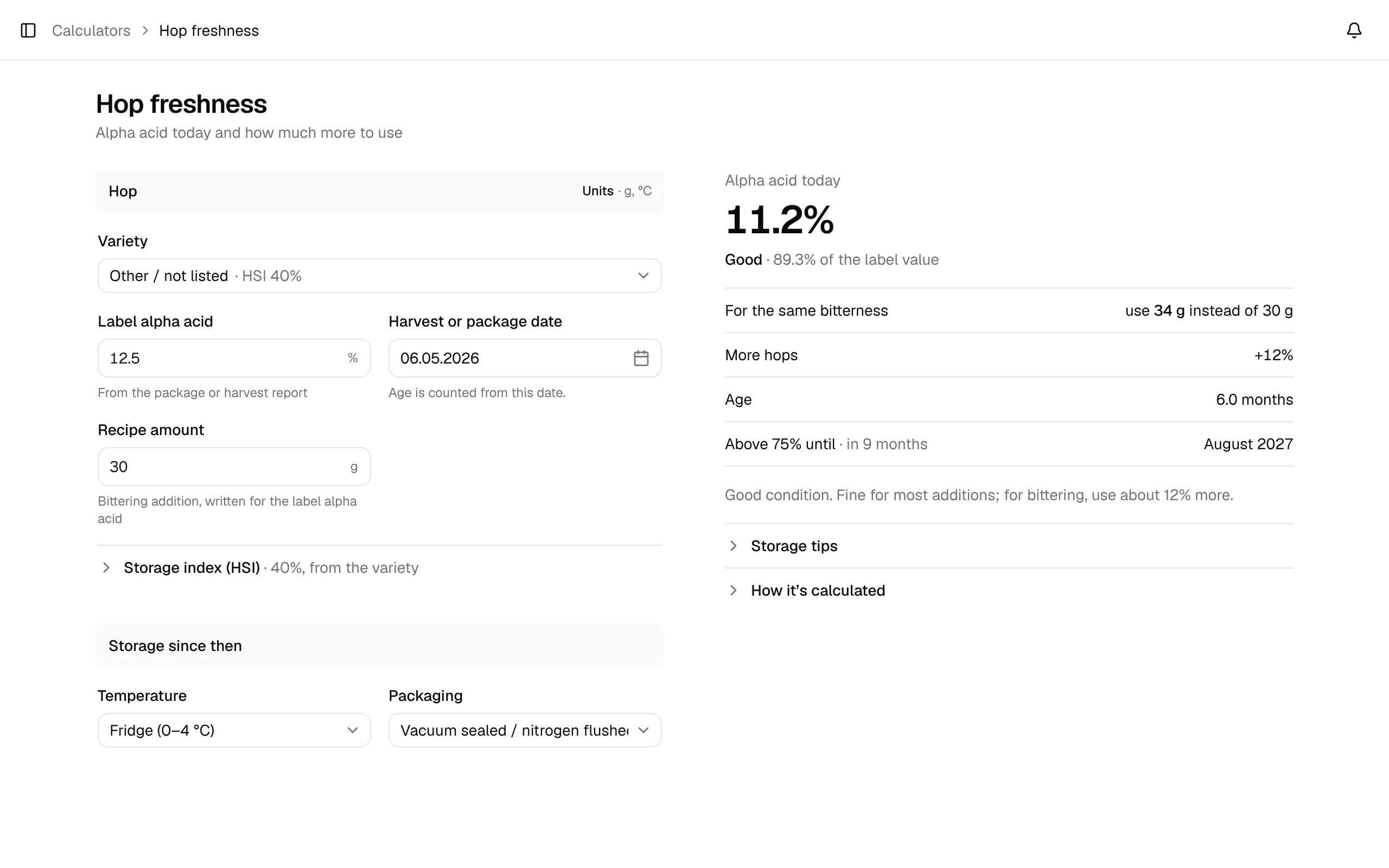
Use it with your inventory
The calculator works on the numbers you type in; it doesn't read your inventory. Your inventory items hold what it needs:
Open the hop in the Hops section of the Inventory and note its Alpha acid (the value of your lot) and Harvest Year.
Open Calculators in the sidebar → Hop freshness.
In the Hop section, choose the Variety (it sets the Storage index (HSI); pick Other / not listed for anything else), enter the Label alpha acid, the Harvest or package date and the Recipe amount of your bittering addition. Your inventory only has the harvest year: pick a date in that year's harvest season, or the date you bought or opened the pack. If your supplier lists an HSI for your lot, open the Storage index (HSI) fold and type it in. To work in ounces and °F, use Units in the section bar.
Under Storage since then, pick the Temperature and Packaging the hops were kept at.
Read Alpha acid today and For the same bitterness. To keep the aged value with your stock, enter it as the item's Alpha acid in the inventory (edit an item).
Results
| Result | Meaning |
|---|---|
| Rating (under the big number) | Excellent (90 % or more of the label value left), Good (75 % or more), Fair (50 % or more), Poor (25 % or more), Degraded (less) |
| Alpha acid today | The big number: estimated alpha acid, with the share of the label value that is left |
| For the same bitterness | How much to use instead of the recipe amount |
| More hops | How many percent more that is, or No change needed |
| Age | Months since the harvest or package date |
| Above 75% until | The month the hops will drop below 75 % of the label value under the same storage (and in how many months), or Already below |
| Recommendation | The line below the results: what the hops are still good for |
Under the results, Storage tips and How it's calculated open as folds.
How it's calculated
AA today = AA label × (1 − HSI / 100) ^ (days / 180 × TF × SF)
AA label: the alpha acid on the package, in %.HSI(Hop Storage Index): the percentage of alpha acid a variety loses in 6 months (180 days) at 20 °C in open air.days: days since the harvest or package date.TF(temperature factor):2 ^ ((T − 20) / 15), so the loss halves for every 15 °C colder. BrewForge uses one temperature per option: Freezer −18 °C → 0.17, Fridge 2 °C → 0.44, Cool room 12.5 °C → 0.71, Room temperature 20 °C → 1.00, Warm 25 °C → 1.26.SF(storage factor): Vacuum sealed / nitrogen flushed 0.5, Sealed bag (no vacuum) 0.75, Opened and resealed 0.75, Loose / open container 1.0.
Example: 12.5 % alpha acid, HSI 40, 183 days in the fridge, vacuum sealed. TF × SF = 0.435 × 0.5 = 0.218, the exponent is 183 / 180 × 0.218 = 0.221, and 0.6 ^ 0.221 = 0.893. So 12.5 % × 0.893 = 11.2 % alpha acid today, 89.3 % of the label value.
Room temperature and loose storage give TF × SF = 1: after 180 days the hops have lost exactly their HSI.
amount today = recipe amount × AA label / AA today
increase = (AA label / AA today − 1) × 100 %, rounded to whole percent. Bitterness (IBU) scales with the alpha acid you add, so this brings the same IBU. AA today is taken with two decimals, as shown.
Example: 30 g × 12.5 / 11.16 = 33.6 g, shown as 34 g, which is 12 % more hops.
The age in months is days / 30.44. Above 75% until searches for the date on which the same formula reaches 75 % of the label value.
The model and factors follow Mark Garetz, Using Hops (1994). It is an estimate: actual losses depend on the lot, the oxygen in the bag and how often it was opened. If your supplier gives a fresh analysis, use that value.