Priming Sugar and Force Carbonation Calculator
Priming sugar calculator for bottling (table sugar, dextrose, DME, honey) with per-bottle amounts, and the keg regulator pressure for force carbonation in PSI or bar.
The Carbonation calculator has two modes, switched at the top: Bottles · priming sugar for bottle conditioning and Keg · force carbonation for kegs. Both start from the carbonation you want, the target CO₂.
Open it under Calculators in the sidebar → Carbonation. Enter your values on the left; the answer on the right updates as you type (on a phone it stays pinned at the bottom of the screen).
Target
The Target section is shared by both modes, so switching keeps your values:
- Beer style (optional): pick a style to fill in a typical target. The list shows each style's range, and below the field you see Typical for this style (for example German Lager 4.7–5.3 g/L or 2.4–2.7 vol).
- Target CO₂: in vol or g/L. 1 vol = 1.96 g/L. English recipes usually give volumes, German ones g/L. The default is 2.4 vol (4.7 g/L).
Units in the section bar sets the units for this calculator: CO₂ (vol or g/L), Temperature (°C or °F) and, in the bottle mode, Volume (L or gal). They start in your units from Settings; switching converts the values you entered. The sugar weight follows your weight setting (grams, or ounces with the grams next to them), the keg pressure your pressure setting.
Bottles · priming sugar
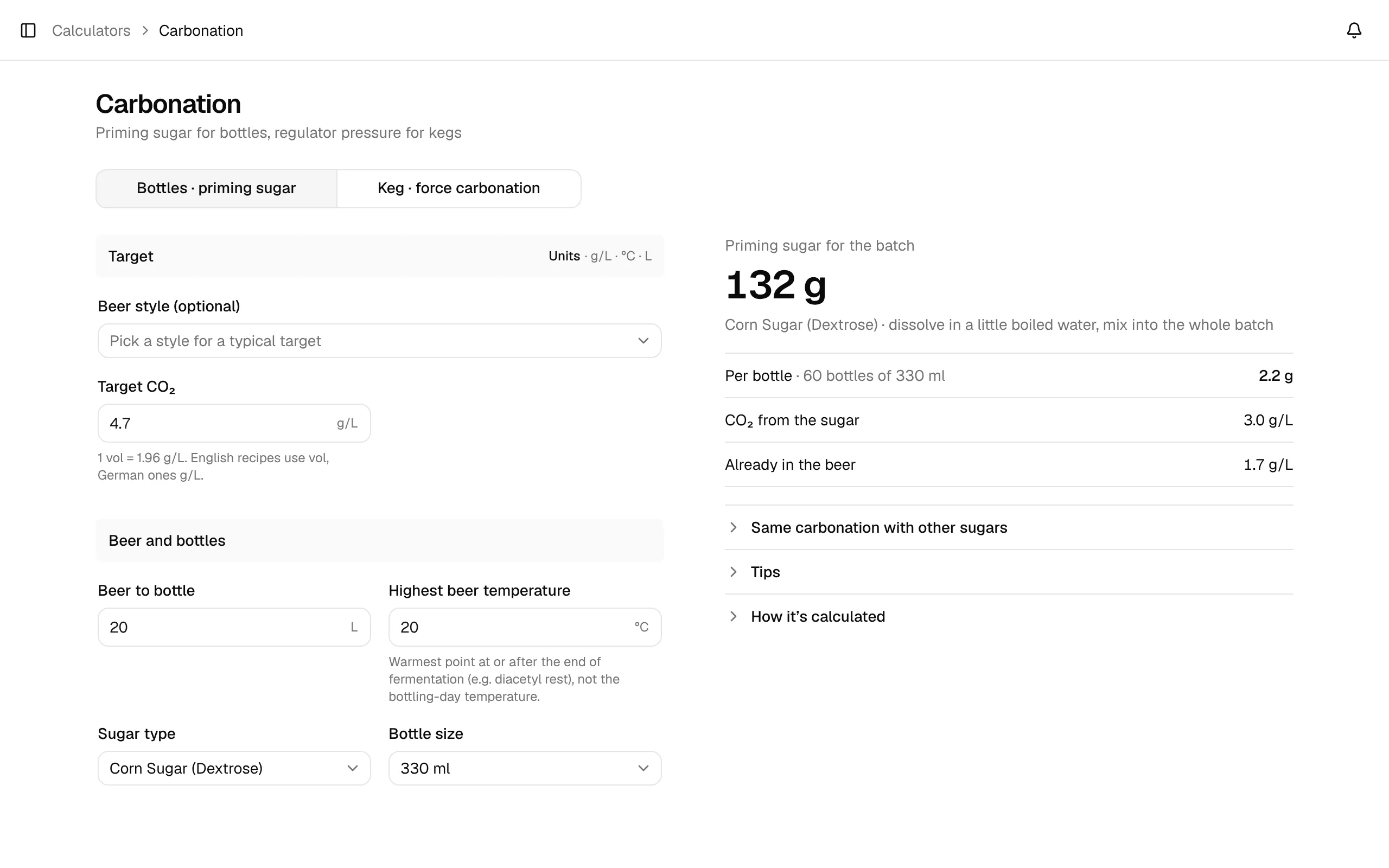
The Beer and bottles section:
| Field | What to enter |
|---|---|
| Beer to bottle | The volume you actually bottle. Default 20 L (5 gal). |
| Highest beer temperature | The warmest point at or after the end of fermentation (for example a diacetyl rest), not the temperature on bottling day. Warmer beer holds less CO₂, so it needs more sugar. Default 20 °C (68 °F). |
| Sugar type | Table Sugar (Sucrose), Corn Sugar (Dextrose), Dry Malt Extract or Honey. |
| Bottle size | 330 ml, 355 ml (12 oz), 375 ml, 500 ml, 650 ml (22 oz), 750 ml or 1 L, for the amount per bottle. |
The answer is the Priming sugar for the batch: dissolve it in a little boiled water and mix it into the whole batch. Below it:
- Per bottle, with the number of full bottles the batch fills (for example "60 bottles of 330 ml").
- CO₂ from the sugar: what the sugar has to add.
- Already in the beer: the CO₂ the beer still holds from fermentation.
Three folds open below the answer: Same carbonation with other sugars (a table with the amount for each sugar type, your choice highlighted), Tips and How it's calculated.
If the beer already holds as much CO₂ as your target, the answer is 0 with No priming sugar needed: bottle it as is or raise the target. Above 3.0 vol (5.9 g/L) the target field turns red and Use strong bottles warns that standard beer bottles can burst; use bottles made for high carbonation.
CO₂ still dissolved in the beer at its highest temperature T in °F (capped at 94.3 °F / 34.6 °C, the minimum of the curve):
V₀ = 3.0378 − 0.050062 × T + 0.00026555 × T²
sugar (g) = (V − V₀) × L × f
with V the target in vol, L the liters of beer and f the sugar factor in grams per liter and vol: table sugar 3.82 (from the chemistry of sucrose), corn sugar 4.3, dry malt extract 5.33, honey 4.9 (after Palmer, How to Brew). The total is rounded to 0.1 g; per bottle it is sugar / L × bottle size. Full bottles = L / bottle size, rounded down.
Example: 2.4 vol (4.7 g/L) in 20 L at 20 °C (68 °F). V₀ = 3.0378 − 3.4042 + 1.2279 = 0.86 vol, so the sugar adds 1.54 vol. Corn sugar: 1.54 × 20 × 4.3 = 132.3 g, 2.2 g per 330 ml bottle (60 bottles). With table sugar 117.5 g, dry malt extract 164 g, honey 150.8 g.
Keg · force carbonation
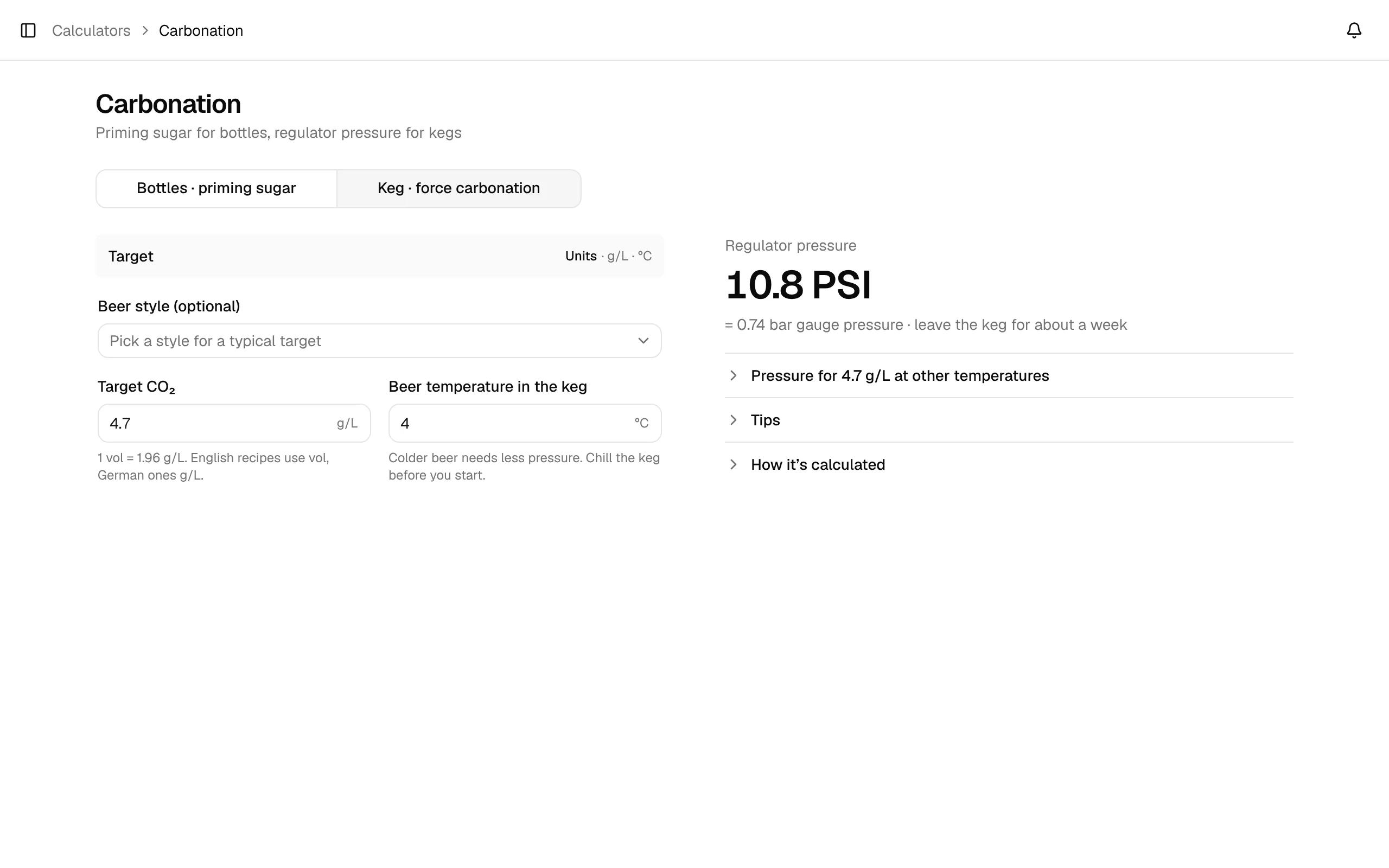
In this mode the Target section gets one more field, Beer temperature in the keg (default 4 °C / 38 °F). Colder beer needs less pressure, so chill the keg before you start.
The answer is the Regulator pressure in your pressure unit from Settings (PSI or bar), with the other unit below as gauge pressure. Leave the keg at that pressure for about a week.
The folds below the answer:
- Pressure for … at other temperatures: a table with the pressure for your target at 0–12 °C in 2 °C steps (32–56 °F in 4 °F steps), in both pressure units. Your temperature is highlighted (added as its own row if it is not on the grid).
- Tips: the quick method (raise the pressure by about 10 psi / 0.7 bar, shake the keg for 2–3 minutes, then go back to the calculated pressure).
- How it's calculated.
With T the beer temperature in °F and V the target in vol:
P (psi) = −16.6999 − 0.0101059 × T + 0.00116512 × T² + 0.173354 × T × V + 4.24267 × V − 0.0684226 × V²
A curve fit of commercial carbonation tables. The result is gauge pressure, rounded to 0.1 psi and never below 0. bar = psi × 0.0689476.
Example: 2.4 vol at 4 °C (39.2 °F): −16.6999 − 0.3962 + 1.7904 + 16.3091 + 10.1824 − 0.3941 = 10.8 psi (0.74 bar). At 10 °C the same target needs 16.3 psi.
Related
- Spunding valve: carbonate with the yeast's own CO₂ instead.
- Calculator API:
GET /api/public/calc/priming-sugarandGET /api/public/calc/force-carbonation