Yeast Pitch Rate and Starter Calculator
Yeast pitch rate calculator: cells needed for your batch, viability of liquid or dry yeast by date, and the starter size, DME and steps (stir plate or shaken) to reach it.
Pitching enough healthy yeast is one of the biggest levers on fermentation quality. The yeast calculator works out how many cells your batch needs, how many are still alive in the packs you have, and whether to make a starter or pitch more packs.
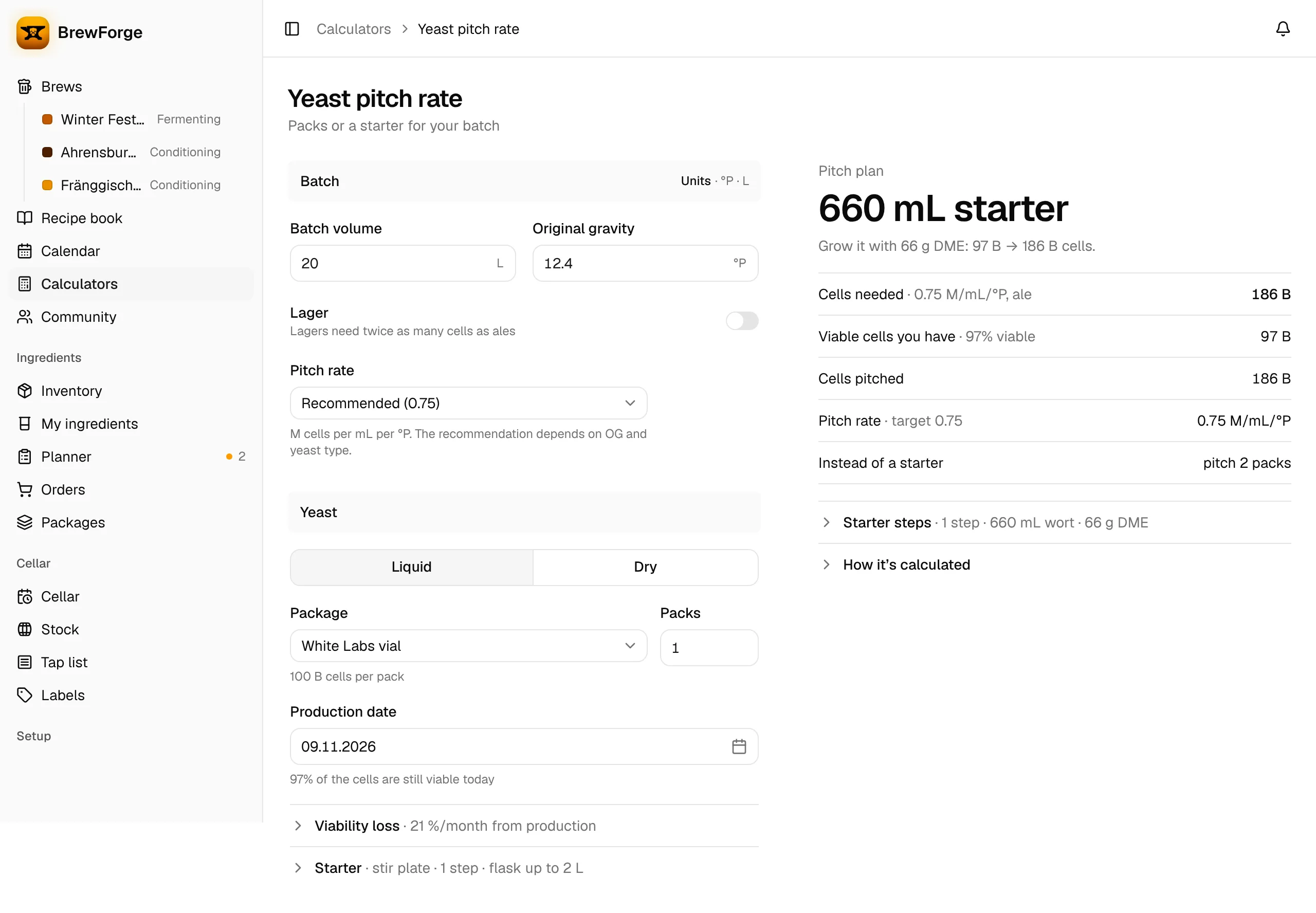
Open it with Calculators in the sidebar → Yeast pitch rate. From a brew, the Calculator button in the Yeast section of the Recipe tab (or Yeast calculator… in the section's ⋯ menu) opens it with the recipe's batch volume and original gravity filled in, and Lager switched on when the recipe has a lager yeast.
Inputs
The inputs sit in two sections. The Units button in the Batch bar switches gravity between SG and °P and volume between L and gal; it starts with your settings and converts the values you entered.
Batch
| Field | What to enter |
|---|---|
| Batch volume | Liters or gallons going into the fermenter. |
| Original gravity | SG or °P. |
| Lager | On for lager yeast: lagers need twice as many cells as ales. |
| Pitch rate | Recommended (from OG and Lager, see below), one of the presets for ales and lagers, or Custom in million cells per mL per °P, for example when your yeast lab gives a rate. |
Yeast
| Field | What to enter |
|---|---|
| Liquid / Dry | The kind of yeast. Switching resets the package, the date and the viability loss to that kind's defaults. |
| Package | Liquid: White Labs vial, Wyeast smack pack (100 B cells each) or Imperial pouch (200 B). Dry: 11 g packet (200 B). Or Other (enter cells) and type the Cells per pack in billions. |
| Packs | How many packs you have. |
| Production date (liquid) / Best-before date (dry) | From the pack. Liquid yeast starts at today, dry yeast at one year ahead. The line below says how many of the cells are still viable today. |
Two closed folds below hold the less common settings; their titles show the current values:
- Viability loss: the Viability loss per month. Default 21 % for liquid yeast from the production date, 1.5 % for dry yeast after the best-before date.
- Starter (liquid yeast only, dry yeast isn't grown in a starter): Stir plate on for a stirred starter (Braukaiser growth model), off for a shaken one (White curve). Starter steps: 1, 2 or 3, each in fresh wort. Largest flask: 1, 2, 3 or 5 L; no step is planned bigger than this. Defaults: stir plate, 1 step, 2 L.
The pitch plan
The answer on the right is the Pitch plan. Its big line tells you what to do:
- … pack is enough / … packs are enough (… packet is enough for dry yeast): you have enough viable cells, no starter needed.
- Pitch … packets: dry yeast doesn't go into a starter, so the plan pitches more packets instead.
- … starter (for example 660 mL starter): one starter step, with the DME it needs and how the cells grow (
97 B → 186 B cells). With 2 or 3 steps it reads …-step starter, with the largest step and the DME of all steps together. If you have more than one pack, Start with … packs says they all go into the starter. - If the starter can't reach the target with your flask and steps, a note says where it tops out and how many fresh packs to pitch with it, plus how many steps (or which bigger flask) would reach the target.
Below the big line:
- Cells needed, with the pitch rate used (for example
0.75 M/mL/°P, ale). - Viable cells you have, with today's viability.
- Cells pitched when you follow the plan.
- Pitch rate you reach, next to the target rate.
- Instead of a starter (only when the plan is a starter): how many packs you'd pitch without one.
Under the results, the Starter steps fold lists each step with its Wort volume, DME and Cells after. Starter volumes show in mL below 1 L and in L above, also when you work in gallons; DME shows in grams, or ounces when the batch is in gallons. How it's calculated shows the formulas.
Pitch rate in million cells per mL per °Plato: ale 0.75, ale above OG 1.065 1.0, above 1.085 1.25, lager 1.5, lager above OG 1.060 2.0 (White and Zainasheff). A rate you pick under Pitch rate replaces it.
cells needed (billion) = volume in mL × °Plato × pitch rate / 1000
Viability, liquid yeast: 97 % × e^(−k × days since production) with k = −ln(1 − monthly loss) / 30.44, the same as 97 % × (1 − monthly loss)^months. With the default 21 % per month that is 97 % on day 0 and about 77 % after a month.
Viability, dry yeast: 100 % until the best-before date, then e^(−k × days past it) with the same k (1.5 % per month).
Starter, stir plate (Braukaiser): the starter wort has 100 g DME per liter (about 1.036 SG). While the starting cells are at most 1.4 billion per gram of DME, every gram grows 1.4 billion new cells; above that growth drops to 2.33 − 0.67 × cells per gram and stops at 3.5 billion per gram.
Starter, shaken (White / Zainasheff): new cells per starting cell 12.548 × x^−0.4595 − 0.9995, with x the starting cells in million per mL, capped at 200 million cells per mL of starter.
With several steps, the growth is split evenly so every step multiplies the cells by about the same factor. Each step gets the smallest volume that reaches its share, at most the flask size.
Example (the defaults): 20 L of 12.4 °P (1.050) ale wort needs 20,000 × 12.4 × 0.75 / 1000 = 186 billion cells. A White Labs vial (100 billion) produced today is 97 % viable: 97 billion cells. On a stir plate, a 0.66 L starter has 66 g DME, so 97 / 66 = 1.47 billion cells per gram, just above 1.4: each gram grows 2.33 − 0.67 × 1.47 ≈ 1.35 billion cells, 66 × 1.35 ≈ 89 billion new cells, 97 + 89 = 186 billion. Without a starter you'd need 186 / 97 → 2 packs.
The same vial produced 30 days ago is 97 % × 0.79^(30/30.44) ≈ 76.9 % viable (76.9 billion cells, about 1 billion per gram of the starter below), so the starter grows the full 1.4 billion per gram: 109.1 / 1.4 = 78 g DME in a 0.78 L starter. An 11 g dry packet (200 billion, before its best-before date) covers the batch on its own.
Related
- Calculator API:
GET /api/public/calc/yeast-pitch-rate